What Is an Annotated Bibliography?
An annotated bibliography is a list of sources, books, journal articles, websites, and reports, where each entry includes two things: a formatted citation and a short paragraph (the annotation) that summarises and evaluates the source.
The citation tells your reader what the source is. The annotation tells them why it matters, what the source argues, how reliable it is, and how it connects to your research.
Here is what a single entry looks like:
Johnson, A. M. (2018). Exploring the impact of technology on education. Journal of Educational Technology, 42(3), 125–140.
This article examines how technological tools have changed classroom instruction over the past two decades. Johnson draws on longitudinal survey data from 400 schools and finds that technology adoption improved student engagement but did not consistently raise test scores. The study is valuable for research on ed-tech policy because it distinguishes between engagement and learning outcomes, a distinction many popular articles blur.
That entry has three layers:
- The citation
- A summary of what the source says
- An evaluation of why it is useful.
That is the whole format. |
What Are the Three Parts of an Annotated Bibliography?
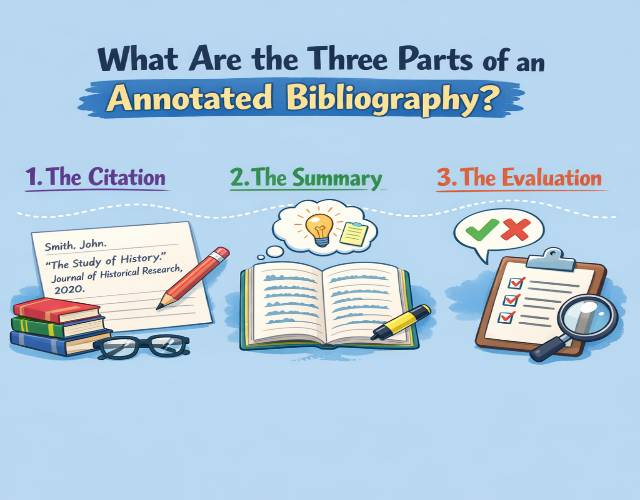
Every annotation, regardless of citation style, contains three components:
1. The citation
Formatted to your required style (APA, MLA, Chicago, Harvard). This is the reference information: author, date, title, publication details. It follows the exact same rules as a regular bibliography entry. |
2. The summary
A brief description of the source's main argument, methodology, or findings. You are answering: What does this source say? Keep it to two or three sentences. Do not quote the source directly; paraphrase in your own words. |
3. The evaluation
Your assessment of the source's relevance, reliability, and usefulness to your specific research question. You are answering: Why does this source matter for my project? This is the part that distinguishes an annotated bibliography from a plain reference list. CollegeEssay.org's writing team reviews roughly 300 annotated bibliography submissions per month. The most common failure in evaluative annotations is treating a limitation as a disqualifier rather than a useful caveat. |
Some assignments ask for only a summary (descriptive annotation). Others ask for a summary plus evaluation (evaluative annotation). A few ask for a third layer, your personal reflection on how the source changed your thinking (reflective annotation). Check your assignment brief to confirm which type is required before you start.
What Are the 4 Types of Annotations, and Which One Does Your Assignment Require?
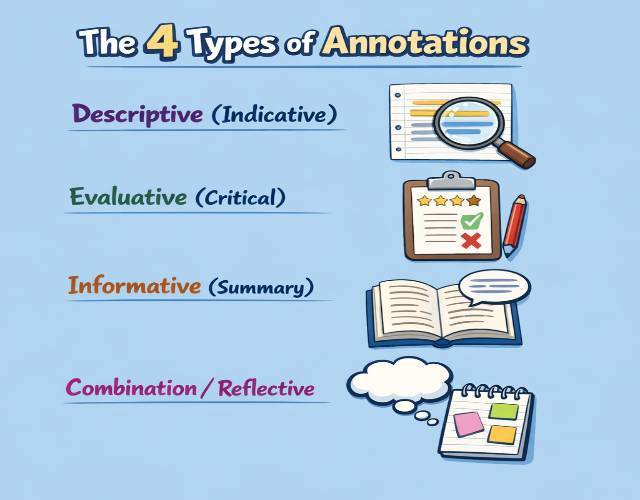
Before you write a single word, confirm which type your assignment requires. Using the wrong type is the most common structural mistake students make.
Descriptive (Indicative)
Summarises the source's content and main points without offering any judgement. Useful when your professor wants a record of sources rather than your assessment.
Example: "This chapter covers the historical development of citation practices in academic publishing, tracing changes from the 18th century to the present. The author organises the material chronologically and focuses primarily on North American and European traditions." |
Evaluative (Critical)
It goes beyond summary to assess the source's strengths, weaknesses, credibility, and relevance to your research. This is the most commonly required type at the undergraduate and graduate levels.
Example: "The chapter provides useful historical context but relies heavily on secondary sources. The author's claims about 18th-century practices are not always substantiated with primary evidence, which limits the study's authority for historical claims. Still, the overview of citation norms post-1950 is well-sourced and directly relevant to arguments about modern academic formatting." |
Informative (Summary)
A detailed description that covers purpose, methodology, findings, and conclusions. More thorough than a descriptive annotation, but it still does not evaluate.
Example: "Segal's book examines the role of technology in education from the 1960s to the present, covering the introduction of personal computers in classrooms, the rise of ed-tech platforms, and debates around screen time. The author draws on government data, institutional reports, and longitudinal school studies. Key findings address the gap between technology investment and measurable learning outcomes across different income brackets." |
Combination/Reflective
It incorporates both evaluation and a personal reflection on how the source influenced your research direction or changed your thinking. More common at the graduate level.
Example: "Kahn's text offers a solid introduction to research methodology but covers data analysis techniques only briefly, which limits its usefulness for quantitative projects. Despite this gap, the source reshaped how I approached my literature search; the chapter on ethical research design prompted me to reconsider two of my original sources and replace them with peer-reviewed alternatives." |
If your assignment brief still isn’t clear on which type is required, or you’ve worked through all four and the whole thing still feels like a lot to execute correctly under a deadline, you can get professional annotated bibliography help directly: tell us your subject, citation style, deadline, and source count, and our writers handle every entry from citation to annotation.
How to Write an Annotated Bibliography Step by Step (5 Step Process)
Step 1: Choose Your Sources
Start with your research question, not with a keyword search. Your sources need to directly address your question, not just touch on your general topic. A source about "social media" is not automatically useful for a paper about "social media's effect on adolescent sleep patterns."
Look for: - Peer-reviewed journal articles (Google Scholar, JSTOR, PubMed)
- Academic books from university presses
- Government reports and institutional research
- Recent publications (within the last 10 years for most topics; science and medicine often require 5 years)
Avoid: - Opinion pieces
- Wikipedia
- Non-peer-reviewed blogs
- Sources you cannot verify.
|
Step 2: Write the Citation First
Before you write a word of annotation, format your citation correctly. This matters because the citation is the anchor of the whole entry; getting the author's name or date wrong undermines the entire reference.
Use your required citation style: APA format or MLA format. Both pages include annotations for every source type.
Key details to record for every source:
- Author(s), last name and first initial(s)
- Publication year
- Full title (article and journal, or book title)
- Volume, issue, page numbers (for articles)
- Publisher and location (for books)
- DOI or URL (for online sources)
|
Step 3: Write the Summary
Read the source fully before writing a word. Then close it and write the summary from memory; this forces paraphrasing and prevents accidental plagiarism.
Your summary should answer:
- What is the source's central argument or main finding?
- What methodology or approach did the author use?
- What is the scope, who or what does it study, and over what period?
|
Two to three sentences are usually sufficient. Do not quote the source directly in the annotation. Do not evaluate yet, save that for step 4.
Step 4: Write the Evaluation
Now assess the source. Ask yourself:
- Authority: What are the author's credentials? Is the journal peer-reviewed? Is the publisher reputable?
- Accuracy: Are the claims supported by evidence? Does the methodology hold up?
- Currency: How recent is the source? Does the publication date matter for your topic?
- Relevance: How directly does this source support your specific research question?
- Bias or limitations: Does the author have an apparent agenda? Are there gaps in the study?
|
One to two sentences of honest evaluation are more useful than three sentences of vague praise. If a source has a real limitation, name it.
Once all entries are written:
- Arrange alphabetically by the first author's last name
- Apply your required spacing (double-space throughout in APA and MLA)
- Apply hanging indent to each entry
- Confirm that your citation format is consistent across all entries. The most common error is mixing APA and MLA conventions within the same bibliography
|
A completed entry in APA format looks like this:
Williams, P. (2020). How to write an annotated bibliography in APA format. The Classroom. https://www.theclassroom.com/write-annotated-bibliography-apa-format-3443.html
This brief guide explains the structural requirements of an APA annotated bibliography, covering citation format, annotation length, and spacing rules. It is targeted at students with no prior experience of APA style and provides clear step-by-step instructions. While the source is not peer-reviewed, it accurately reflects APA 7th edition guidelines and is useful as a quick-reference check for formatting decisions.
If you still cannot find a solid topic to anchor your research around, our annotated bibliography topics guide lists 200 options organised by subject, difficulty, and source availability.
You now have the complete writing process. The part most students find hardest isn't understanding the steps; it's executing them correctly across ten or fifteen sources under a real deadline, with formatting rules that differ by style and professors who notice every spacing error. If you are short on time? Ask us to write my annotated bibliography and get polished annotations, correct formatting, and reliable sources, fast.
|
Annotated Bibliography vs. Literature Review vs. Abstract
These three terms appear in the same academic context and are often confused. They are not the same thing.
| Annotated Bibliography | Literature Review | Abstract |
|---|
| What it is | A list of sources with individual annotations | A synthesised essay discussing sources together | A summary of one document |
| Structure | Entry by entry, source by source | Flowing prose, organised by theme or argument | Paragraph at the top of a paper |
| Purpose | Document, evaluate, and organise your sources | Analyse the state of knowledge on a topic | Give readers a preview of one piece of work |
| Perspective | Source-level: what does this source contribute? | Topic-level: what does the body of research tell us? | Document-level: what does this paper do? |
| Length per source | 50–200 words | Not applicable (sources are woven in, not listed separately) | Not applicable |
The practical difference
- In an annotated bibliography, you treat each source separately and evaluate it on its own terms.
- In a literature review, you pull multiple sources together to build an argument about the field.
A literature review often uses an annotated bibliography as a preparation step; you annotate your sources first to understand them, then synthesise them in the review.
If your assignment says annotated bibliography, you are writing entry-by-entry. If it says literature review, you are writing an essay.
How Long Should an Annotated Bibliography Be?
Each annotation should be 100 to 150 words, and the number of sources depends entirely on your assignment; most undergraduate papers require 5–15 sources. CollegeEssay.org's writers find that annotations under 80 words rarely complete both the summary and evaluation, while those over 200 words tend to over-explain rather than assess."
Annotation length
Each individual annotation should be 50–200 words. Most fall between 100 and 150 words. That is roughly two to four short paragraphs, one to summarise, one to evaluate, and one (optional) to reflect. If your professor specifies a word count per annotation, follow that. If not, aim for 150 words and adjust based on how complex the source is.
Number of sources
This depends entirely on your assignment. Common requirements:
- Introductory undergraduate paper: 5–8 sources
- Upper-division research paper: 10–15 sources
- Graduate seminar or thesis chapter: 15–30+ sources
If your brief specifies a source count, that is the number. If it does not, a good rule of thumb is one source per page of the final paper.
Total length
There is no fixed page count for an annotated bibliography itself. A 10-source annotated bibliography with 150-word annotations will run approximately 3 to 4 pages double-spaced. Longer is not better; completeness and precision are what matter.
Does an Annotated Bibliography Need to Be Double Spaced?
Yes, in APA and MLA format, annotated bibliographies follow the same spacing rules as the rest of your paper, which means double spacing throughout. This includes the space between the citation line and the annotation, and between separate entries.
Chicago style typically uses single spacing within each entry and double spacing between entries.
If your assignment does not specify a style guide, ask your professor. When in doubt, double spacing is the safer default.
For indentation: APA uses a hanging indent (first line flush left, subsequent lines indented 0.5 inches). MLA uses the same hanging indent format for both the citation and the annotation. The annotation itself is not additionally indented in MLA; it continues at the same hanging indent level. |
Your professor will specify which style to use. Here is how the three most common styles handle annotated bibliographies differently:
APA (American Psychological Association)
Used in psychology, education, and social sciences. Annotations are double-spaced, left-aligned, with a hanging indent. Additional paragraphs within one annotation are indented an extra 0.5 inches.
MLA (Modern Language Association)
Used in humanities, literature, language, film, and cultural studies. Annotations use a double-spaced hanging indent; the annotation paragraph is not additionally indented beyond the citation's hanging indent.
Chicago Style
Used in history, arts, and some social sciences. Entries are single-spaced with a hanging indent; annotations are double-spaced, left-aligned, and indented. Chicago allows longer, more narrative annotations than APA or MLA.
Useful Vocabulary for Annotated Bibliography
- Hanging indent: the formatting rule where the first line of each citation is flush with the left margin, and all subsequent lines are indented 0.5 inches. Applied in APA, MLA, and Chicago.
- Peer-reviewed: a source that was evaluated by independent subject experts before publication. Peer-reviewed sources carry more academic authority than non-peer-reviewed ones.
- Primary source: original material: a study's raw data, an original text, a historical document, an interview. Creates the evidence.
- Secondary source: a source that analyses or interprets primary sources. Most academic journal articles are secondary sources.
- Descriptive annotation: summarises content only, no evaluation.
- DOI (Digital Object Identifier): a permanent URL assigned to academic articles. Always include the DOI in APA citations when one is available.
- Evaluative annotation: summarises and assesses the source's value and reliability.
You now have the full process, the format rules, and the vocabulary. What remains is the actual work: finding credible sources, summarising each one accurately, and formatting every citation without a single spacing or punctuation error. If your deadline is tighter than your schedule, CollegeEssay.org's annotated bibliography assistance can take it from there. Send your topic, required style, and number of sources for a finished bibliography in 24 hours. |